

Full Press Release from Marriage Foundation
0001 Thursday 20th August 2026
In the wake of Taylor Swift’s star-studded wedding to NFL star Travis Kelce at Madison Square Garden on 3 July, a major new book from Dr Harry Benson claims the so-called Swiftie generation is “desperately” seeking reliable love and still sees marriage as the gold standard of relationships.
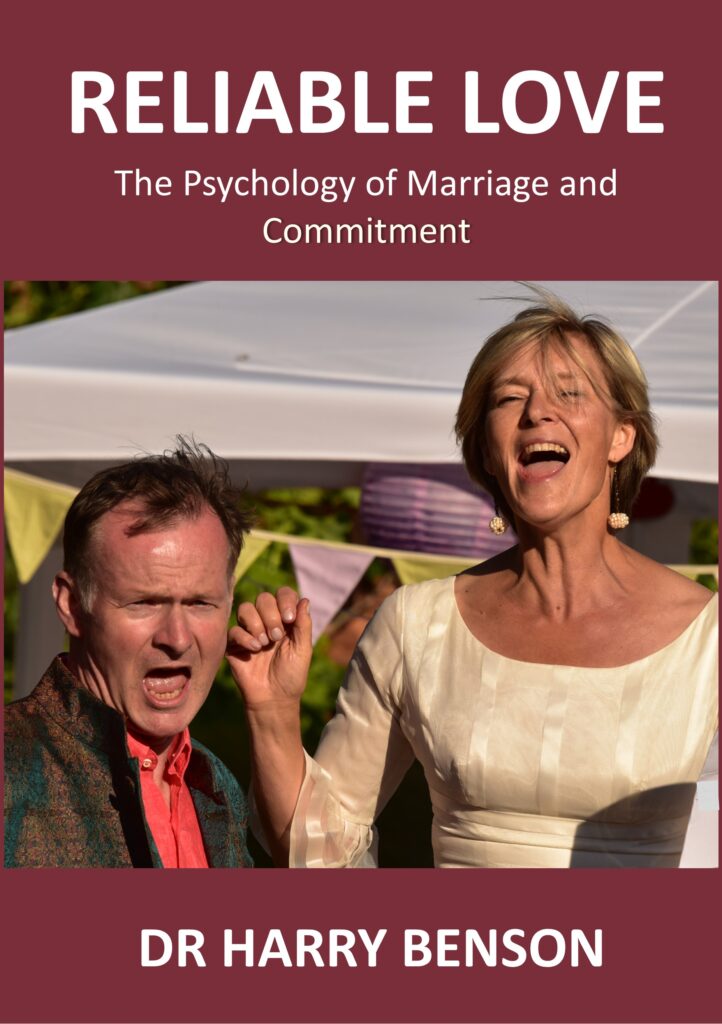
The book, RELIABLE LOVE – The Psychology of Marriage and Commitment, pulls together decades of research that found over nine in ten young people (93 per cent of men and 96 per cent of women) agree that marriage is a very strong or fairly strong sign of commitment in a relationship and nearly nine in 10 want to marry.
Most astonishingly of all, the poorest couples who marry are less likely to split up than the richest cohabitees (page 204). A fact that challenges the deeply flawed assumptions that married couples have better stability rates because they are better off, older and more educated.
While acknowledging that marriage rates have declined in the UK, the book demonstrates that so have divorce rates. Indeed, detailed research conducted by Dr Benson for the Marriage Foundation confirmed that divorce rates are at their lowest since the 1970s.
The epidemic of family breakdown, as he points out in the book, which has risen fivefold between the 1970s and 2010s, is not due to the divorce rate going up, “the problem is not divorce, the end of marriages, but the growing number of breakups among couples who never married,” he says. Arguing that marriage “stacks the odds in your favour”, because it is underpinned by clarity, commitment and sends a clear signal. Conversely, not getting married and cohabiting increases risks of family breakdown because of ambiguity, inertia or drift and is inherently more fragile.
Dr Harry Benson, Research Director of the Marriage Foundation and author of the book, commented: “Taylor Swift’s wedding is wonderful news and proof that the vast majority of young people aspire to marry. Indeed, you only have to listen to the lyrics of her song to hear her desire to wed. In her song So Long London, written after her break-up with actor Joe Alwyn, following a six year relationship, she wrote ‘You swore that you loved me but where were the clues? I died on the altar waiting for the proof’. My research has found strong evidence that she is speaking for a whole generation of young women who feel the same.”
He continued, “Whether you call them Gen Z, Swifites or just young people, they understand the importance of marriage and the statement it makes. These sentiments are regardless of wealth, but because of the psychology behind marriage — the desire to find reliable love, love we can trust — is what most young people want. Marriage provides this by each person committing to a life together and then celebrating that commitment in front of their friends and family.”
The book goes on to explain the decline of in marriage rates is largely, but not exclusively down to “commitment shy” men, who by a margin of 2:1 are more likely to drag their heels, while at the same time viewing marriage as less urgent in their 20s than women, but more urgent once they hit their 30s, indeed overtaking women by 79 per cent versus 73 per cent.
“Men do eventually want to get married”, Dr Benson writes, “It used to be that boys had to prove themselves in order to get the girl. The price of sex was commitment. No more. Now it’s all on a plate. The result is ambiguity. And ambiguity is a relationship killer. How can we find reliable love if we don’t know where we stand? Maybe the old way wasn’t that bad after all”.
“Even if young adults no longer have to go through the social, psychological and legal gateway of marriage in order to sleep with one another, almost all acknowledge that marriage is the ultimate sign of commitment and reliable love.
“Yet it seems we have lost confidence in marriage due to our modern acceptance of cohabitation and unwillingness to make judgements about those who don’t marry. We value marriage intuitively, but we find it hard to express how or why marriage differs from mere cohabitation.
“Where there is a gender difference in attitudes to marriage, it seems that men are more inclined than women to delay marriage until their 30s, by which time more women have given up hope of getting married.”
Dr Benson, uses several case studies from the extensive interviews he carried out to illustrate his argument, before explaining commitment theory and the psychology that underpins marriage and why even the poorest married couples are less likely to split up than the richest cohabitees.
The book also takes aim at the academics and politicians who believe that marriage has become merely a status symbol for the better off. Much of this flawed thinking, in the UK at least, comes from two studies by the IFS conducted in 2010 and 2013. “Their conclusion was that all – or almost all – of the lower dissolution risk experienced by couples who were married rather than unmarried could be explained by the selection effect, background factors such as age, education and income. Their conclusion was that it’s being older, better educated or richer that helps couples stay together, not being married,” the book says.
“Here’s my problem with this perspective. Selection undoubtedly explains part of the story, but only part. It seems absurd to ignore the reality that most people still do want to marry, even though they no longer have to, and to dismiss the act of marriage as making no psychological difference whatsoever to the way couples think and behave after they have got married.”
Dr Benson goes on to explain how, in reviewing the IFS studies as part of his PHD, he identified a flaw in them – a quarter of the data was missing. Having rerun the study with the missing data, he was able to conclude that marriage had a significant impact on stability, accounting for fully a half of the difference. Put in numbers, the probability of splitting up among those who married at any stage was just 26 per cent, compared to 46 per cent of those who never marry.
“The greater stability found among couples who marry, regardless of the timing of marriage, is also consistent with two other important theories. When people get married, they are making a decision followed by an action. Cognitive consistency theory says their attitudes and behaviour should then align in a way that is consistent with the decision and action taken. Signal theory says that the decision to marry sends a signal to each spouse about their mutual commitment. Words are cheap. But the act of marriage in front of family and friends necessarily involves the sacrifice of alternatives and a willingness to embrace the higher exit barriers.”
He continued: “Marriage is more than a piece of paper. It changes how couples think about their future together. It provides clarity where there might otherwise be ambiguity, signals commitment to one another, and creates a shared expectation that the relationship is intended to last.”
Drawing on psychology, behavioural science and original doctoral research, Reliable Love argues that understanding the psychology of commitment is essential if we want to understand why some relationships flourish while others drift apart. He concludes his book with this simple advice: choose well, decide clearly, commit fully and get married.
RELIABLE LOVE – The Psychology of Marriage and Commitment was released on Saturday 1st August and is available from Amazon.
ENDS
Notes to editors
About Marriage Foundation
Marriage Foundation was founded in 2012 by Sir Paul Coleridge, a High Court judge who was moved by his personal experience in 40 years as a barrister and judge specialising in family law. The think tank seeks to improve public understanding of marriage and to reduce the numbers of people drawn into the family justice system – some 500,000 children and adults each year. It has established itself as a leading voice on marriage issues in the UK.
Harry Benson from the Marriage Foundation is available for comment and for interviews linked to the book and his new findings.
For all media enquiries, please contact Alistair Thompson on 07970 162225