
Read our new report on mums and life satisfaction here
Mothers who marry and stay together are the most likely of all groups of parents to report high life satisfaction fourteen years into parenthood. Mothers who marry but divorce are no less likely to be satisfied than any other group
Just over half (52%) of the 3,700 mothers in this sample from the Millennium Cohort Study, all of whom had their first child in 2000-02, reported being ‘highly satisfied’ with their life when their child was aged fourteen, scoring 8 or more out of 10.
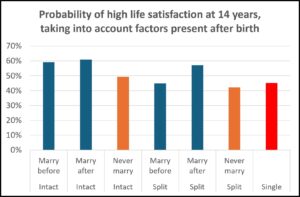
There was, however, substantial variation between groups of mothers. Even after taking account a wide range of background factors measured soon after the birth, including the mother’s age, education, ethnicity, income, psychological distress and initial level of life satisfaction, the adjusted probabilities of high life satisfaction were 59% among mothers who married before the birth, 61% among those who married afterwards and 49% among those who stayed together but never married.
Among mothers whose relationships ended, including those who re-partnered, the probability of high life satisfaction was 45% for those who married before the birth, 57% for those who married afterwards, 42% for those who never married and 45% for those who started out as lone mothers. These probabilities do not differ significantly in statistical terms.
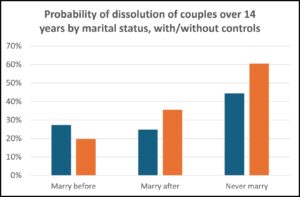
Marriage was also associated with a substantially greater likelihood that parents stayed together. Once again taking into account a wide range of background factors, including initial levels of life satisfaction, the estimated probability of dissolution was 27% among parents who married before their child was born, 25% among those who married afterwards and 44% among those who never married. In other words, the corresponding probabilities of remaining together were 73%, 75% and 56%.
In summary, the greatest likelihood of being highly satisfied with life as a mother of a fourteen-year-old was found among those who married and stayed together. The fact that married couples who remained together were more likely to report high life satisfaction than couples of similar background who also remained together but never married suggests that something about marriage itself, or the process of deciding to marry, may contribute to greater satisfaction.