
This paper, written by Marriage Foundation research director Dr Harry Benson, was published by the Centre for Social Justice. You can visit their website and download the paper here.
Child poverty and inequality in the UK cannot be fully understood without addressing family stability. While successive governments have focused on income transfers, employment, and early years provision, far less attention has been paid to whether parents stay together. Yet family breakdown remains one of the most consistent predictors of long-term disadvantage for children.
This report presents new evidence from longitudinal analysis of UK parents, drawing on recent doctoral research. It shows that family stability is not simply a reflection of economic advantage but is strongly associated with marriage itself.
- Most strikingly, over the first fourteen years of parenthood, parents in the poorest fifth of households who marry at any point are less likely to separate – even after controlling for a wide range of socio-economic and demographic characteristics – than parents in the richest fifth who never marry.
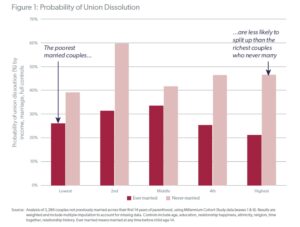
This finding challenges a central assumption in public policy: that differences in family stability largely reflect underlying socio-economic characteristics such as income, education, or age. Instead, the evidence suggests that family structure plays an independent and powerful role in shaping outcomes.
The analysis also shows that stability and mobility are closely linked.
- Parents who remain together are significantly more likely to move up the income distribution over time, while those who separate are more likely to fall into lower income quintiles.
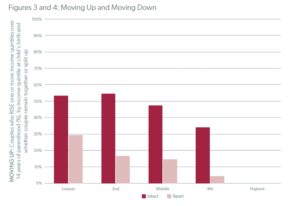
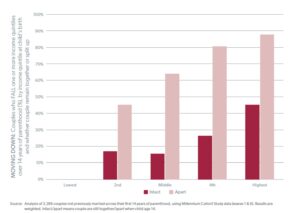
Family breakdown is therefore not only associated with poverty; it is a key mechanism through which poverty persists and deepens.
These conclusions differ in important respects from earlier influential studies, particularly those by the Institute for Fiscal Studies. By extending these analyses, incorporating the full sample, and applying improved methodology, this report finds that marriage itself accounts for a substantial share of the difference in outcomes between couples who marry and those who do not.
If this is correct, then policies that are neutral on marriage are not neutral in effect. A strategy to reduce poverty that overlooks family stability will remain incomplete. The Government should therefore act to remove barriers to marriage, integrate family stability into its poverty strategy, and strengthen support for couples in the early years of parenthood. These reforms are not only socially important but fiscally prudent, addressing the root causes of disadvantage rather than its symptoms.
Dr Harry Benson, July 2026