
Our new report summarises the findings of Dr Harry Benson’s PhD thesis. You can download the full thesis via this link
- The benefits of marriage have been systematically underestimated in academic research and public policy. This is the central finding of my PhD thesis, recently completed at the University of Bristol.
- This finding matters because the UK is experiencing record levels of family breakdown, with profound consequences for children, public finances, and inequality, at the same time as marriage has retreated from parenthood. Understanding whether marriage itself contributes to stability is therefore a critical policy question.
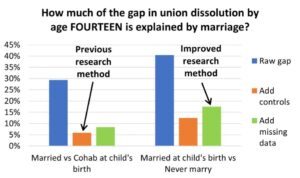
- Using longitudinal data on 3,324 couples followed for up to fourteen years in the Millennium Cohort Study, my thesis replicates and extends influential analyses by the Institute for Fiscal Studies. Those studies concluded that married parents stay together longer than unmarried parents largely because they are older, better educated, and better off.
- However, their conclusions rest on a major methodological limitation: analysing only three quarters of parents in their survey sample. My analysis of the entire sample, using improved state-of-the-art methodology, shows that marriage accounts for half or more of the gap in union dissolution.
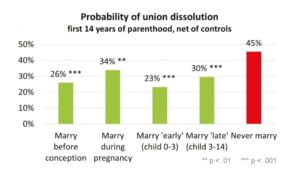
- In short, being married substantially increases the chances that parents stay together, regardless of when marriage occurs – before, during, or after pregnancy – and regardless of socio-economic background.
- These findings are consistent with well-established psychological theories that have been largely neglected in sociological research. Commitment theory, cognitive consistency theory, and signal theory all suggest that marriage functions as a commitment device, reinforcing dedication, aligning behaviour with long-term intentions, and increasing the costs of exit. The results also align closely with the long-term shift away from marriage and the rise in family instability.
- If marriage itself contributes to stability, then policies that are neutral on marriage are not neutral in effect. Reducing social and fiscal barriers to marriage could therefore play a meaningful role in strengthening family stability and reducing the long-run social and economic costs of family breakdown.
Dr Harry Benson, Research Director, Marriage Foundation, June 2026